From a sermon on Genesis 22
Abraham was tested and asked to offer his son as a sacrifice. From his life the sermon draws three connected points on how to walk with God: Priority to God, Complete Faith and Obedience.
Abraham’s test
- His life is an example. From it we learn how to walk with God: how God called him, guided him and led him, how Abraham was close to God, and how he was tested.
- Our faith is tested too. “Yes, there are times that our faith also will be tested.” Testing always produces something great (1 Peter 1:6-7).
- Genesis 22:12. “Do not lay a hand on the boy… Do not do anything to him. Now I know.”
1. Priority to God
Based on His Greatness
- Abraham’s protest. Can God ask you to do this kind of thing? This is not fair. “You know I haven’t asked, or maybe I lost my hope, and finally you gave.”
- Why does God ask? If I don’t give Him priority, what is He going to lose? He doesn’t lose anything. Then why does He ask for priority in your life?
- His answer. When God becomes our highest priority, we allow Him to direct our lives according to His wisdom and His purposes.
- Abraham loved God more than his own son. He reads Matthew 10:37-38 and Luke 14:26: “If anyone comes to me and does not hate father and mother, wife and children, brothers and sisters, even their own life…”
- Gift and giver. God was not asking Abraham to stop loving Isaac, because Isaac was the greatest gift God had given him. Our focus is often on the blessings we have received. We say this job is God-given and my children are God-given gifts.
- Is God first place in your life? “Think through it. Take a time and think.” If God is first, then whatever He says, there is no question at all, we will go and do it.
- The rich young man (Mark). He wanted eternal life and was willing to follow Jesus, but he was rich. Jesus put the question of priority to him: sell all your property, then come and follow me.
- Philippians 3:7-8. “Whatever were gains to me, I now consider loss for the sake of Christ.” He lists the gains: job, work, family, inheritance, position, religion. But God “is not asking you to leave everything.”
- Our plans or God’s plan. Often we live by our own plans. We tell the pastor, “Bless my plan,” and when it fails, it’s easy to blame the pastor: “You prayed and nothing happened.” The alternative is “I make the plan as God has commanded me to do it. There is a difference.” Abraham was not demanding a blessing or running around asking God to bless him. The blessing in chapter 22 is the same as the one when he was called in chapter 12. So should I seek His plan, or make my plan and ask God to bless it?
- God’s plan is complete. His example is NVDA, the chip company, whose founder worked in a coffee shop and made a lot of money in 33 years. That was the maximum anyone planned. But when God plans something for us, “it is not about 10 years plan… not about 100 years of plan. The entire plan of God is complete. That is the wisdom of God.”
- “My God is big.” Understanding the greatness of God is the foundation of this first point.
2. Complete Faith
In Him and His Promises
- Not knowing how. “I don’t know how He is going to work. I believe in the promise that He gave me.”
- Romans 4. Paul says Abraham believed God. God is capable and able to do the promise He has given.
- Impossible situations. Are there impossible situations in your life? “We tried and we tried and it’s not happening… If it is possible, you would have done it. It is not possible by us.”
- How God’s greatness comes to us. As we hear God’s way and see the life of God’s people, we see why the stories of Abraham, Jacob and Moses are in the Bible. The opposite story is in the Bible too. And he invites testimonies, because what we want to hear is what God has done in your life.
- Abraham. He did not know exactly how God would work, but he knew the greatness of the God in whom he believed.
- Hebrews 11. The list of people who lived by faith gives Abraham a good part of the chapter.
3. Obedience
Walking With Him
- Faith in action. Abraham worked to obey God’s commandments: “Faith has come into an action.” Whatever God says, “I’m going to do it.” This is where God reaffirmed His covenant with Abraham, in chapter 12 and again in chapter 22.
- Challenges on the way. His journey continued, and challenges and issues came up, but “one thing is sure: I will obey God.”
- Walking with God. “Obedience means walking with God.” Enoch walked with God. God is a spirit, so it is not like walking with a man. It means walking close to Him, as Abraham, Enoch and Noah did.
- Not just asking for blessings. Walking means every day you have a closer relationship with God. You are aligned with His will and seek His will in your life, so that “His desire, His purpose, His will becomes my will.”
- Galatians 2:20. We are crucified with Christ, which means I am with Christ. In the New Testament, walking with God or walking according to the Holy Spirit is all about our lifestyle.
- Not by sight. He points to 2 Corinthians 5, where Paul speaks of unseen things, eternity and the future. Today I have a job, health, a bank balance and friends, and tomorrow I may not. “I do not walk with things around.”
How the three fit together
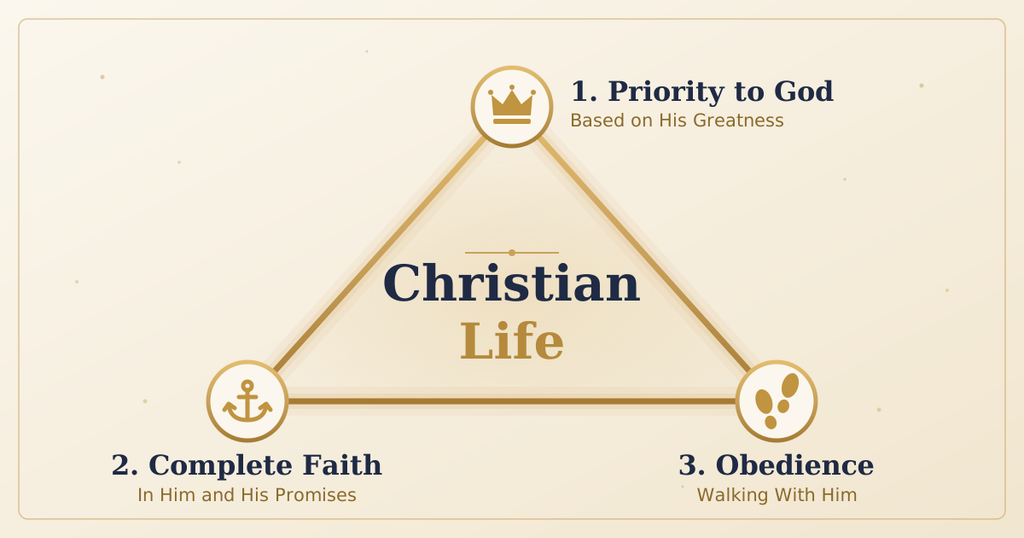
- They are one triangle. Priority to God is based on His greatness, the second point is complete faith, and obedience is action based on these two things. “It is not independent one from another.” Together they are the completeness of our Christian life.
- His challenge. What really gives you trouble this morning? We know God is there, but things around us are shaking. “Abraham was just like a man and a person like each one of us.”
- God’s plans are greater. Parents have desires about us, but God’s plans are much greater, “not just for a few years but for eternity.”
Something to ask yourself: “Is this from the Lord or not? Is this your wisdom? Is this your plan? Or are we walking with God, according to the greater plan that God has placed in your life?”